Posts

Why should You Migrate to Cloud-Native design?
Image
  Developing an application is a challenging process. The architecture and engineering choices need careful planning to ensure performance, security, and a great user experience. But the big fat question is, should you migrate your on-premises applications to the cloud or opt for a  cloud-native design.   Cloud adoption transfers the technology and support of the underlying infrastructure from the IT team to the cloud provider.  A cloud approach offers many benefits, including more database options and integrations with other services. But before you decide to migrate your on-premise apps, consider the following things: Consider database needs : The most important component for most applications is the database. The monolithic application design was the favored choice in an enterprise landscape for years. However, it is complex and has the benefits of first-in, first-out data processing simplicity. On-demand resources:  with a monolithic de...

Importance of Kubernetes multi-cluster management

Image
  Businesses are increasingly deploying multiple Kubernetes clusters to enhance availability, flexibility, isolation, and scalability. Multi-cluster is a method for deploying an application across multiple Kubernetes clusters to improve availability.  Kubernetes multi-cluster management   can be implemented to ensure compliance with distinct and conflicting regulations. The speed and security of software delivery can also be improved. Individual development teams deploy applications to isolate clusters and specifically expose which services are available for testing and release.    Better operational readiness:  troubleshooting, associated operational runbook, and tools are simplified with standardizing cluster creation. It alleviates common sources of operational errors while reducing the cognitive load for support engineers, which leads to improved response time.    No vendor lock-ins:  a multi-cluster strat...

How is Kubernetes changing the DevOps space?

Image
  Kubernetes has seen drastic growth over the past few years and businesses are leveraging containers for complex applications, micro-services, and cloud-native applications. With the rampant growth of  standardized Kubernetes ,  DevOps has gained more traction. While they appear very different, one is a tool and the other is the methodology; they work collectively to help businesses deliver fast services.    The Kubernetes DevOps connection Kubernetes helps the team respond to customers' demands without having to stress about the infrastructure layer. The orchestration engine within Kubernetes handles the once manual task of deploying, scaling, and creating more resiliency based on metrics. Kubernetes is crucial for DevOps teams looking to scale, automate and build resiliency in their applications while reducing infrastructure burden.    Deploy everywhere:  Kubernetes has the ability to deploy an application everywhere witho...

What You Should Know About Cloud-Native Applications

Image
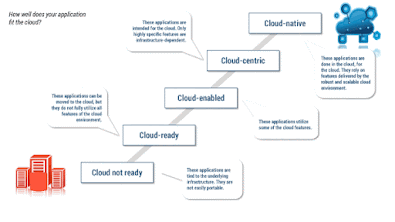
Cloud-native applications are apps that make complete use of the cloud computing revolution. To take full advantage of  Cloud-native operations , one needs to ensure that the application design is decoupled from physical infrastructure. Moreover, the application should be divided into services and tiers. Each service and tier should be developed & run independently. Here are the main features that define Cloud-Native Applications. Multiple services:  each application can further be split down into services called Microservices. These services co-operate with each other. However, it appears to the end customer that they are reaching a single application. Elasticity:  the applications and their services should scale in-out and up-down in case the demand increases.  Compatibility:  each service is programmed in a way that other applications can consume it. It is generally done via APIs that have well-defined behavior....

Discover the future of cloud with edge computing solutions

Image
For businesses looking to break beyond the limitations, traditional cloud-based networks impose, edge computing solutions can make all the difference. However, cloud computing plays an essential role in modern network architecture; the exciting opportunities offered by the Internet of Things (IoT) devices, which can concoct the data they collect closer to the source, drive companies to rethink their approach to IT infrastructure. What is edge computing? Traditional cloud computing networks are incredibly centralized, with data being collected on the exterior edges and conveyed back to the main servers for processing. This architecture grew because most of the gadgets located near the edge require the computational power and storage volume to examine or process the data they collected. Even as more devices connected to networks over cellular and WiFi, their functionality was relatively limited by their hardware capabilities. Why do you need edge computing? The biggest advantage of an e...

Support your digital transformation with edge computing solutions

Image
  Edge computing is a term used to represent decentralized IT infrastructure. In , applications, computation, and data storage are all carried out near the source of the data, as opposed to in the cloud or at an offsite data center. Edge servers deliver enhanced performance by processing data locally and reducing the distance between devices and servers. It requires less bandwidth and decreases latency. How does it work? Traditional IT infrastructure needs data to be conveyed across long distances and multiple network connections. It may require ample bandwidth and hardware. Edge computing leads compute and storage resources closer to where the data is created, decreasing the distance it has to travel. Rather than pushing the data off to the cloud or shoving it to a central data center, it enables for real-time processing of applications within close physical proximity to the end-user. Why is edge computing necessary? Edge computing is crucial to address lapses in cloud-based appli...

How to Architect Applications for Kubernetes

Image
Creating and running modern applications with portability, scalability, and robustness in mind can be a daunting task, particularly when the system complexity increases. The architecture of an application or system potentially affects how it must be run, what it requires from its environment, and how exactly coupled it is to related components.  Design for scalability: architecture design could be fully bespoke depending on the needs of the software. The ability to scale horizontally remains one of the most crucial determining factors on Kubernetes. Unlike vertical scrolling which uses the least resources for deployment, you need to sustain some copies of your Kubernetes application to accomplish your goal.   Scale using microservices: Kubernetes manages applications as microservices in the form of containers. These containers are grouped into pods. The pods offer stateless or stateful containers depending on the requirements of applications. With Kubernetes imitation, pods...